Lesson 1: What Is the GED and Why Mathematical Reasoning Matters
An introduction to the GED exam, its structure, and the role of the Mathematical Reasoning section — setting the foundation for confident, informed preparation.
Welcome to Your GED Journey
Think back to a moment when a door closed on you — a job you wanted but didn't qualify for, a college program that required a diploma you didn't have, or simply a quiet feeling that something important was left unfinished. Millions of adults carry that feeling every day, and if you're here, you already know exactly what it feels like. The good news? You're already doing something about it. Grab our free flashcards at the end of each section to lock in what you learn — they're one of the fastest ways to build real retention as you study.
This course exists for one reason: to get you across the finish line. Not just to help you survive the GED (General Educational Development) credential exam, but to help you genuinely understand the material — especially the part that trips up most test-takers: Mathematical Reasoning. Before we dive into numbers, formulas, or problem-solving strategies, let's start where every great journey begins — with a clear picture of where you're going and why it matters.
Why the GED Changes Everything
The GED credential is not a consolation prize. It is a full, federally recognized alternative to a high school diploma, accepted by more than 97% of U.S. colleges and universities, as well as the vast majority of employers. When you hand a hiring manager or admissions officer a GED certificate, they see exactly what they would see with a traditional diploma: proof that you have mastered the core academic skills expected of a high school graduate.
🤔 Did you know? More than 20 million adults have earned their GED since the test was first introduced in 1942. The credential was originally designed to help World War II veterans re-enter civilian life — and it has been opening doors ever since.
What does that credential actually open for you?
- 🎯 Higher education — community colleges, four-year universities, trade programs, and certifications all become accessible
- 💼 Better employment — a GED raises your lifetime earning potential significantly; the average GED graduate earns tens of thousands of dollars more over a career than someone without a credential
- 🔒 Greater confidence — the act of earning something difficult changes how you see yourself and how others see you
- 📚 New learning paths — many vocational programs, apprenticeships, and licensing exams require a high school equivalency to even apply
💡 Real-World Example: Maria dropped out of high school at 17 to help support her family. At 34, she decided to earn her GED. Within two years of passing, she was enrolled in a nursing assistant program, and three years after that, she became a licensed practical nurse. The GED wasn't the whole journey — but it was the door she had to walk through first.
The Four Tests You'll Face — and the One That Matters Most Here
The GED is not a single exam. It is a battery of four subject tests, each taken separately, each scored independently. You can pass them one at a time, in any order, on your own schedule. Here's the full picture:
| 📚 Subject Test | ⏱️ Time Allowed | 📝 What It Covers |
|---|---|---|
| 🔤 Reasoning Through Language Arts | 150 minutes | Reading comprehension, grammar, extended writing |
| 🔬 Science | 90 minutes | Life science, physical science, earth/space science |
| 🌍 Social Studies | 70 minutes | U.S. history, civics, geography, economics |
| 🔢 Mathematical Reasoning | 115 minutes | Arithmetic, algebra, geometry, data analysis |
All four tests matter — but Mathematical Reasoning consistently ranks as the most challenging for adult learners. Survey after survey of GED test-takers confirms it: math is the test that causes the most anxiety, requires the most preparation time, and is most often the final hurdle between a learner and their credential.
That's not a coincidence, and it's not because you aren't smart. It's because most adults have been away from formal math instruction for years — sometimes decades — and the brain needs a structured re-introduction. This course is that re-introduction.
🎯 Key Principle: You do not need to remember everything you ever learned in school. You need to rebuild a specific set of skills that the GED Mathematical Reasoning test actually measures — and this course shows you exactly which skills those are.
Starting From the Ground Up — No Math Background Required
Here is one of the most important things you will read in this entire course: you do not need any prior advanced math knowledge to begin. None. This course is built from the very foundation — whole numbers, fractions, decimals — and works its way up systematically to algebra and geometry. Every concept is introduced before it is used. Every skill is explained before it is practiced.
If the word algebra makes your stomach drop, that's a completely normal response. It just means nobody ever explained it to you in a way that made sense. That changes here.
YOUR LEARNING PATH (simplified)

[Basic Arithmetic]
        |
        v
[Fractions & Decimals]
        |
        v
[Ratios, Proportions & Percents]
        |
        v
[Introductory Algebra]
        |
        v
[Geometry & Measurement]
        |
        v
[Data Analysis & Statistics]
        |
        v
[GED Mathematical Reasoning TEST]
Every rung of that ladder is built with care. You won't be asked to climb to the next level before the one below it is solid. That's the design principle of this entire course.
💡 Pro Tip: Research on adult learning consistently shows that people learn math faster when they understand why a concept matters before they learn how to apply it. Throughout this course, we lead with purpose before procedure.
Why Understanding the Exam Before Studying It Saves You Time
Most people make a critical mistake when they start preparing for a big test: they dive straight into content review without first understanding the exam itself. This is like packing for a trip without knowing the destination — you might bring everything, or you might bring entirely the wrong things.
❌ Wrong thinking: "I'll just study all the math I remember from school and hope for the best."
✅ Correct thinking: "I'll first learn exactly what the GED Mathematical Reasoning test measures, then build a targeted study plan around those specific skills."
Knowing the structure of the exam before you study it gives you three powerful advantages:
- Efficiency — You spend time only on what the test actually covers, not on topics that won't appear
- Reduced anxiety — Test anxiety often comes from fearing the unknown; familiarity with the format makes the exam feel manageable
- Strategic preparation — Certain question types reward specific skills; knowing this lets you practice the right way
⚠️ Common Mistake: Many learners spend weeks drilling advanced algebra without realizing that basic number sense and data interpretation make up a substantial portion of the test. Knowing the content breakdown prevents this mismatch.
The next sections of this lesson give you exactly that foundation — a detailed map of what the GED Mathematical Reasoning test looks like, how it is scored, and what tools you are allowed to use on test day.
What Success on the GED Actually Looks Like
Let's be honest about something: passing the GED is not easy. It requires real effort, consistent study time, and the willingness to sit with discomfort when a concept doesn't click right away. Anyone who tells you otherwise is setting you up for a surprise.
But here's what's equally true: it is absolutely within your reach. The GED is designed to be passable by dedicated adult learners who commit to structured preparation. The test makers are not trying to trick you. They are measuring whether you have reached a defined level of academic readiness — and that level, with the right guidance, is achievable.
🧠 Mnemonic: Think of the letters GED as standing for Grit, Effort, Determination. Those three qualities matter more than natural ability when it comes to passing this exam.
Here is what you can realistically expect when you earn your GED:
- 🎓 College admission — most community colleges accept GED graduates for immediate enrollment
- 💰 Higher wages — GED holders earn measurably more over a lifetime than those without a credential
- 🔧 Vocational opportunities — trade schools, apprenticeship programs, and professional certifications open up
- 🧠 Personal achievement — perhaps most importantly, finishing something you started builds a self-image that carries into everything else you do
📋 Quick Reference Card: What You'll Accomplish in This Course
| 🎯 Goal | 📚 How We Get There |
|---|---|
| 🔒 Understand the GED structure | Lesson 1: Full exam overview |
| 🔢 Build math skills from scratch | Lessons 2–8: Progressive skill building |
| 🧮 Master test-specific strategies | Lessons 9–10: Practice and technique |
| 📝 Simulate real test conditions | Final practice tests with full review |
| ✅ Walk in confident on test day | Ongoing review, flashcards, and checkpoints |
You Belong Here
Before we move forward, there is one more thing worth saying plainly: you belong in this course. It doesn't matter how long ago you left school, what your grades were, or how many times you've started and stopped studying in the past. None of that determines what happens from this moment forward.
What matters is that you showed up today. You opened this lesson. You're reading these words. That counts.
The road ahead is structured, supportive, and designed for exactly the learner you are — an adult who is ready to invest in themselves and willing to do the work. Every lesson builds on the one before it. Every skill you develop becomes a tool you'll use for the rest of your life, not just on test day.
💡 Remember: Learning is not a race. Move at a pace that allows you to actually understand the material. A slower pace with real comprehension will always outperform a rushed pace with surface-level familiarity.
In the next section, we pull back the curtain on the full GED exam — its structure, its scoring, and exactly what happens from the moment you register to the moment you receive your results. By the time you finish Lesson 1, you'll know this test better than the vast majority of people who sit down to take it.
Let's go.
Understanding the GED Exam: Structure and Overview
Before you can conquer a challenge, you need to understand exactly what you are facing. The GED is not a single, overwhelming test you must pass all at once — it is a carefully structured credential made up of four independent subject tests, each one a manageable goal on its own. Understanding how the GED is built, how it is scored, and how the testing process actually works will transform it from a looming mystery into a clear, achievable plan.
The Four Subject Areas
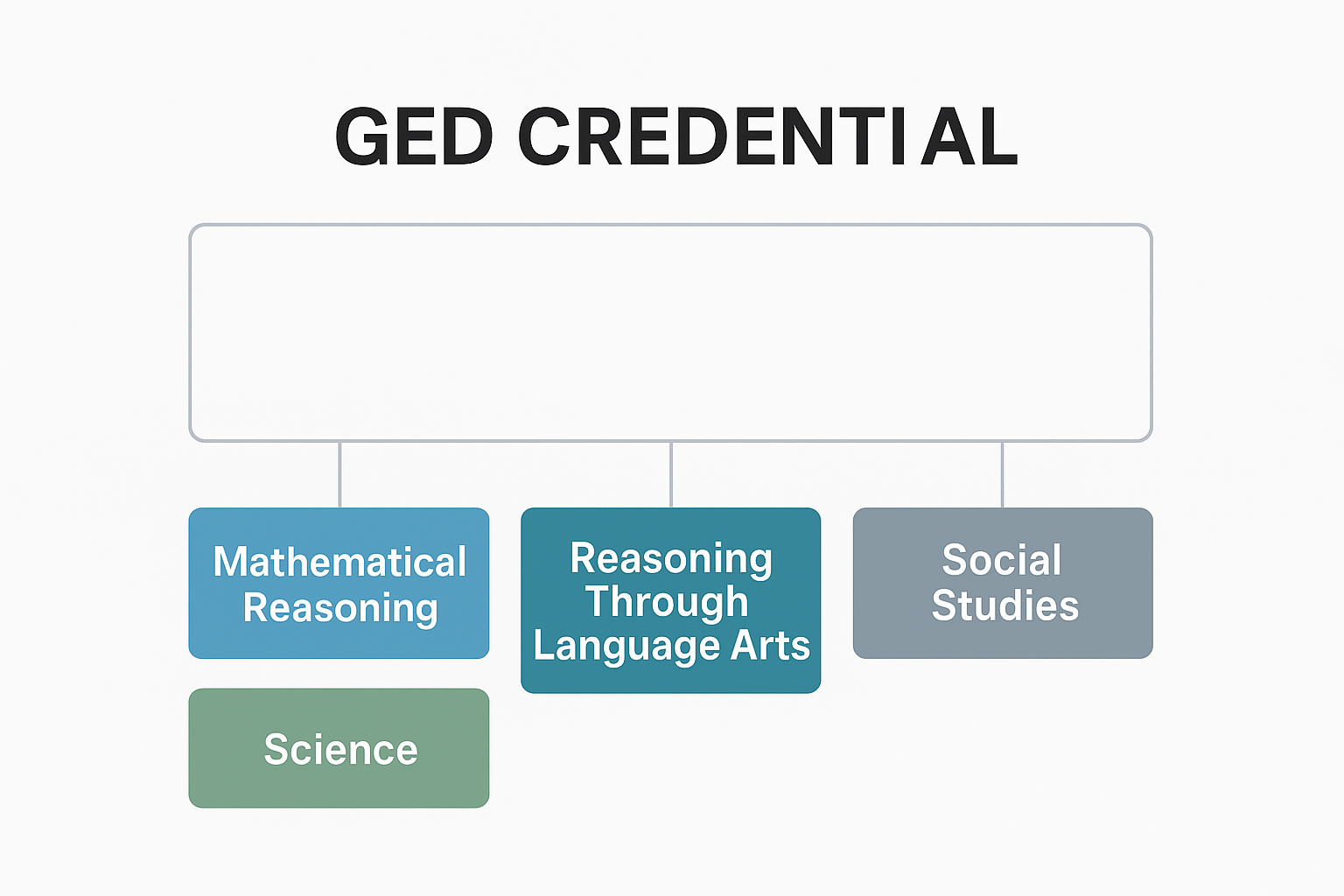
The GED (General Educational Development) exam is designed to certify that a test-taker has academic skills equivalent to a high school graduate. To earn a GED credential, you must pass all four subject tests:
🧠 Mathematical Reasoning — Covers quantitative problem-solving and algebraic thinking 📚 Reasoning Through Language Arts (RLA) — Covers reading comprehension, extended writing, and grammar 🔧 Science — Covers life science, physical science, and earth and space science 🎯 Social Studies — Covers civics, U.S. history, economics, and geography
Think of the GED credential as a four-piece puzzle. Each piece is independent — you can work on one at a time, complete it, set it aside, and move on to the next. You do not need to take all four subjects on the same day, and passing one subject locks in that result permanently while you work toward the others.
View original ASCII
GED CREDENTIAL
┌─────────────────────────────────────────────────┐
│                                                 │
│  ┌─────────────┐        ┌─────────────────┐    │
│  │Mathematical │        │  Reasoning      │    │
│  │  Reasoning  │        │  Through        │    │
│  │             │        │  Language Arts  │    │
│  └─────────────┘        └─────────────────┘    │
│                                                 │
│  ┌─────────────┐        ┌─────────────────┐    │
│  │   Science   │        │  Social         │    │
│  │             │        │  Studies        │    │
│  │             │        │                 │    │
│  └─────────────┘        └─────────────────┘    │
│                                                 │
│   Pass all four = GED High School Credential   │
└─────────────────────────────────────────────────┘
💡 Real-World Example: Imagine Maria, who is strong in reading and social studies but anxious about math. She registers for the RLA test first, passes it with confidence, then studies intensively for Mathematical Reasoning. Because the subjects are independent, her RLA score is safely banked while she focuses all her energy on math. This is exactly how the GED is designed to work in your favor.
How the GED Is Scored
Understanding the scoring system helps you set realistic goals and interpret your results meaningfully. Every GED subject test is scored on a scale from 100 to 200 points. There are three important score benchmarks to know:
| Score Range | What It Means |
|---|---|
| 🔒 100–144 | Below Passing — Test not yet passed; retake required |
| 🎯 145–164 | Passing (GED Passing Score) — Credential earned for this subject |
| 📚 165–174 | GED College Ready — Suggests readiness for college-level coursework |
| 🧠 175–200 | GED College Ready + Credit — May qualify for college credit at some institutions |
The passing score of 145 is your primary goal for earning the credential. However, if you are planning to enroll in college after earning your GED, aiming for 165 or above is a meaningful target. Many community colleges and universities use the 165+ benchmark to determine whether you need to take remedial (non-credit) courses before enrolling in college-level classes. A score of 175 or above may even earn you college credit at participating institutions — meaning your hard work in GED prep could translate directly into a head start in your college career.
🎯 Key Principle: The passing score of 145 is not an arbitrary number — it represents performance equivalent to the bottom 40th percentile of graduating high school seniors. In other words, a passing GED score means you have demonstrated real, comparable academic ability.
🤔 Did you know? The GED Testing Service periodically reviews and adjusts its scoring standards based on research comparing GED performance to high school graduate performance. The current 145 passing threshold has been validated against large national samples of high school students.
Format and Testing Logistics
Computer-Based Testing
The GED is a fully computer-based exam. This means you will be reading questions on a screen, clicking or typing your answers, and using digital tools provided within the testing platform. If you are not comfortable using a computer, this is something to practice before your test date — not something to worry about, but something to prepare for deliberately.
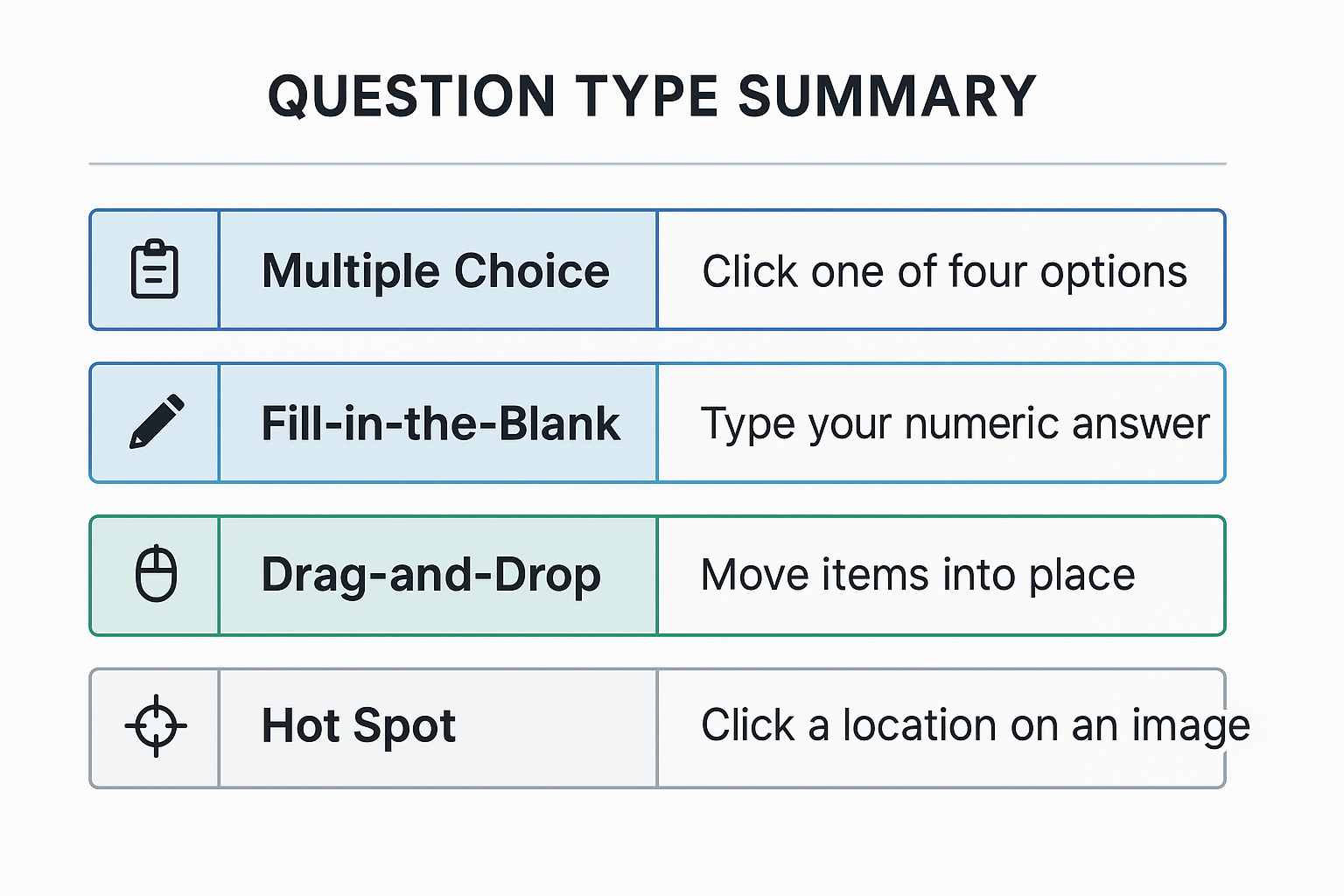
Most questions are multiple choice, but you will also encounter other question formats, including:
📚 Fill-in-the-blank — Type a numeric answer directly 🔧 Drag-and-drop — Move items into the correct order or category 🎯 Hot spot — Click on a specific location in a graphic or diagram 🧠 Drop-down — Select from a short menu embedded in a passage or equation
For the Mathematical Reasoning test specifically, you will work within a digital interface that includes an on-screen calculator for part of the test and an on-screen formula sheet throughout. We will explore those tools in detail in the next section.
Where You Can Take the Test
You have two options for how and where you take the GED:
Option 1 — In-Person Testing Center: You visit an official GED Testing Center — typically located at community colleges, adult education centers, or workforce development facilities. You will sit at a computer in a supervised room. Centers are located throughout the United States and in many international locations.
Option 2 — Online with a Live Proctor: You take the exam at home or in another private location using GED Online Proctoring. A live, remote proctor monitors you via webcam throughout the test. Your computer, internet connection, and testing environment must meet specific technical requirements.
⚠️ Common Mistake: Many test-takers assume that taking the test online at home is easier or less stressful than going to a testing center. In reality, online proctoring has strict requirements — you need a reliable internet connection, a compatible computer with a working webcam and microphone, and a completely private, quiet space. Failing to meet these requirements can result in your session being terminated. Research both options carefully before deciding.
Registration and Cost
To take the GED, you register through the official GED website (GED.com), where you create an account, schedule your test appointments, and access official study materials. The cost per subject test varies by state, but is typically in the range of $20–$40 per subject in the United States, making the full four-test credential accessible compared to many other credentialing exams.
💡 Pro Tip: Some states offer fee waivers or subsidized testing for qualifying test-takers. Check your state's adult education office or the GED.com website for financial assistance programs before paying full price.
Retaking Individual Subject Tests
One of the most empowering aspects of the GED structure is that you can retake individual subject tests if you do not pass on your first attempt. Your passing scores on other subjects remain valid — you only retake the specific test you need to improve.
However, there are waiting period rules between attempts that you must understand:
RETAKE RULES AT A GLANCE

Attempt 1  ──────►  No waiting period to schedule
                         │
                         ▼
              Did not pass?
                         │
                         ▼
Attempt 2  ──────►  Must wait at least 1 day
                         │
                         ▼
              Did not pass again?
                         │
                         ▼
Attempt 3  ──────►  Must wait at least 1 day
                         │
                         ▼
              Did not pass again?
                         │
                         ▼
Attempts 4+ ─────►  Must wait 60 days between attempts
The shift to a 60-day waiting period after three failed attempts is an important detail. It is not a punishment — it is a signal that you should use that time to study more deeply before trying again. Rushing back to retake a test without additional preparation rarely produces different results.
⚠️ Common Mistake: Some test-takers schedule their retake immediately after failing, without adjusting their study approach. If your score was significantly below 145, simply reviewing the same material in the same way is unlikely to move the needle enough. Use every waiting period as focused preparation time.
❌ Wrong thinking: "I just need to take it again and I'll do better with more test experience." ✅ Correct thinking: "I need to analyze which content areas cost me points and specifically study those before my next attempt."
From Registration to Results: The Full Journey
To bring everything together, here is the end-to-end picture of the GED process:
1. CREATE ACCOUNT
   └─► Register at GED.com

2. SCHEDULE TEST
   └─► Choose subject, date, location (center or online)

3. STUDY & PREPARE
   └─► Use official materials + this course

4. TEST DAY
   └─► Arrive early (in-person) or set up environment (online)
   └─► Complete computer-based test

5. RECEIVE SCORES
   └─► Scores typically available within a few hours on GED.com
   └─► 145+ = Subject passed and permanently banked

6. REPEAT FOR REMAINING SUBJECTS
   └─► Tackle subjects one at a time until all four are passed

7. EARN CREDENTIAL
   └─► Official GED transcript and credential available through GED.com
   └─► Can be sent electronically to employers or colleges
🧠 Mnemonic: Think of the GED process as "CSSTRER" — Create, Schedule, Study, Test, Review scores, Earn credential, Repeat if needed. Each letter is a step in your control.
📋 Quick Reference Card:
| 🎯 Feature | 📚 Detail |
|---|---|
| 🔒 Number of Subjects | 4 (Math, RLA, Science, Social Studies) |
| 🎯 Passing Score | 145 per subject |
| 📚 College Ready Score | 165 per subject |
| 🧠 Score Range | 100–200 per subject |
| 🔧 Test Format | Computer-based |
| 🎯 Testing Locations | Official centers or online with proctor |
| 📚 Retake Policy | 1 day wait (attempts 1–3); 60 days (attempt 4+) |
| 🔒 Registration | GED.com |
Knowing this structure thoroughly means you can approach your GED journey as a strategic process rather than a frightening hurdle. Every rule, every format choice, every scoring benchmark exists for a reason — and now that you understand them, you are already better prepared than many test-takers who walk in with only a vague idea of what to expect. In the next section, we will zoom into the Mathematical Reasoning test specifically and give you a detailed map of exactly what skills it tests and how its questions are structured.
Inside the Mathematical Reasoning Test
Now that you have a broad picture of the GED exam as a whole, it's time to zoom in on the test that brings many learners the most anxiety — and the most opportunity. The GED Mathematical Reasoning test is a single, focused assessment designed to measure whether you can think mathematically in real-world situations. Understanding its structure before you begin studying is like reading a map before a road trip: you'll know exactly where you're going, and you won't waste time on wrong turns.
The Big Picture: Time, Questions, and Stakes
The Mathematical Reasoning test gives you 115 minutes to answer approximately 45 questions. That works out to a little over two and a half minutes per question on average — which is tighter than it sounds when some problems require multiple steps. Strong time management is therefore not just helpful; it is essential.
The test is scored on a scale of 100 to 200, and the passing score is 145. This is sometimes called the "college- and career-ready" threshold. While that number can feel intimidating at first, it's worth knowing that you do not need a perfect score — you need a solid, working command of foundational and intermediate math skills.
🎯 Key Principle: You are not being tested on your ability to memorize formulas or perform trick calculations. The GED Mathematical Reasoning test measures your ability to reason — to set up problems, choose strategies, and interpret results.
Two Content Domains: What the Test Actually Covers
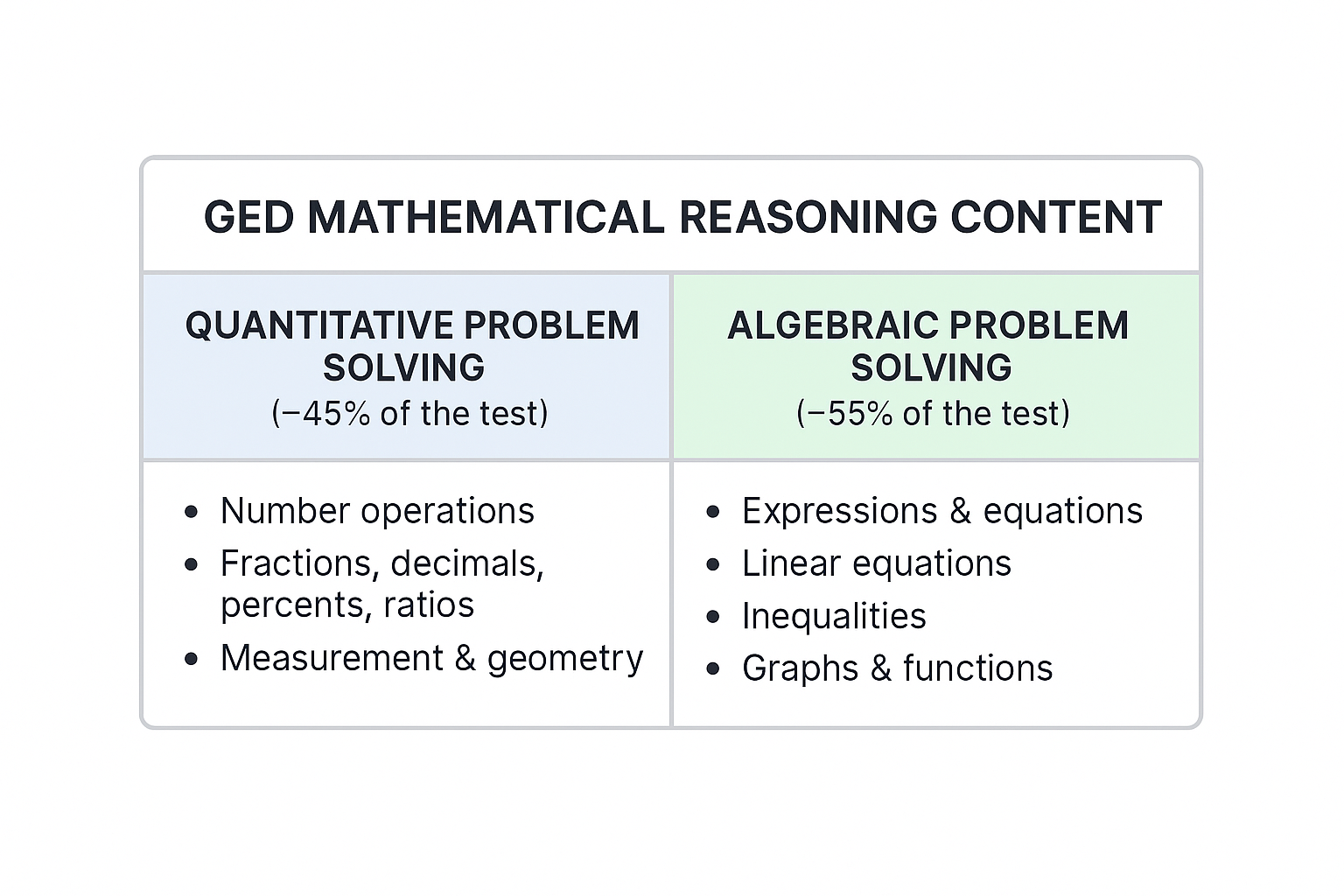
The 45 questions are divided across two major content domains, each representing a slice of what the test values.
View original ASCII
┌──────────────────────────────────────────────────────┐
│         GED MATHEMATICAL REASONING CONTENT           │
├────────────────────────────┬─────────────────────────┤
│  QUANTITATIVE PROBLEM      │  ALGEBRAIC PROBLEM       │
│  SOLVING                   │  SOLVING                 │
│  (~45% of the test)        │  (~55% of the test)      │
├────────────────────────────┼─────────────────────────┤
│ • Number operations        │ • Expressions & equations│
│ • Fractions, decimals,     │ • Linear equations       │
│   percents, ratios         │ • Inequalities           │
│ • Measurement & geometry   │ • Quadratic equations    │
│ • Data, statistics, graphs │ • Functions & patterns   │
└────────────────────────────┴─────────────────────────┘
Quantitative Problem Solving covers the math you encounter in everyday life: comparing prices using percentages, measuring a room to calculate area, reading a bar chart, or working with fractions in a recipe. It accounts for roughly 45% of the test.
Algebraic Problem Solving covers the language of variables, equations, and functions — the tools used to describe relationships and solve for unknowns. At 55% of the test, algebra is the majority of what you'll face. This doesn't mean you should neglect quantitative skills; in fact, algebraic problems often require strong arithmetic foundations. But it does tell you that investing time in algebra will pay the largest dividends.
💡 Pro Tip: Think of quantitative skills as the vocabulary and algebraic skills as the grammar of math. You need both, but learning how to construct and manipulate equations will open more doors on test day.
Question Formats: What You'll Actually See on Screen
One of the biggest surprises for new GED test-takers is that the test is not just a list of multiple-choice questions. The computer-based format allows for several interactive question types, each designed to assess your understanding in a different way. Knowing these formats in advance means you won't lose precious time figuring out the mechanics on test day.
Multiple Choice
The most familiar format. You are presented with a problem and four answer options (A, B, C, D). You click the best answer. These questions reward both solid knowledge and smart elimination strategies.
Fill-in-the-Blank
Also called fill-in-the-blank or "short answer" style, these questions require you to type your answer directly into a box — no options provided. There is nowhere to hide with these. You must calculate the correct answer and enter it precisely.
⚠️ Common Mistake — Mistake 1: Many learners skip fill-in-the-blank questions when they feel uncertain and come back to them later, only to run out of time. It's better to enter your best calculated answer than to leave it blank.
Drag-and-Drop
Drag-and-drop questions ask you to move numbers, expressions, labels, or symbols into correct positions — for example, ordering steps in a solution, placing values on a number line, or matching equations to graphs. These assess whether you understand relationships and order, not just isolated facts.
Hot Spot
Hot spot questions present an image — often a coordinate plane, a number line, or a geometric figure — and ask you to click on a specific point or location that represents the correct answer. Plotting a point on a graph, for instance, is a classic hot spot task.
View original ASCII
QUESTION TYPE SUMMARY
─────────────────────────────────────────────────────
 📋 Multiple Choice   → Click one of four options
 ✏️  Fill-in-the-Blank → Type your numeric answer
 🖱️  Drag-and-Drop     → Move items into place
 🎯 Hot Spot          → Click a location on an image
─────────────────────────────────────────────────────
💡 Mental Model: Think of the question types as different ways of showing what you know. Multiple choice asks, "Can you recognize the right answer?" Fill-in-the-blank asks, "Can you produce it?" Drag-and-drop asks, "Can you organize it?" Hot spot asks, "Can you locate it?"
🤔 Did you know? The drag-and-drop and hot spot formats were introduced specifically because research shows that being able to manipulate information — not just select it — is a stronger indicator of true understanding.
The Calculator Policy: Know Before You Sit Down
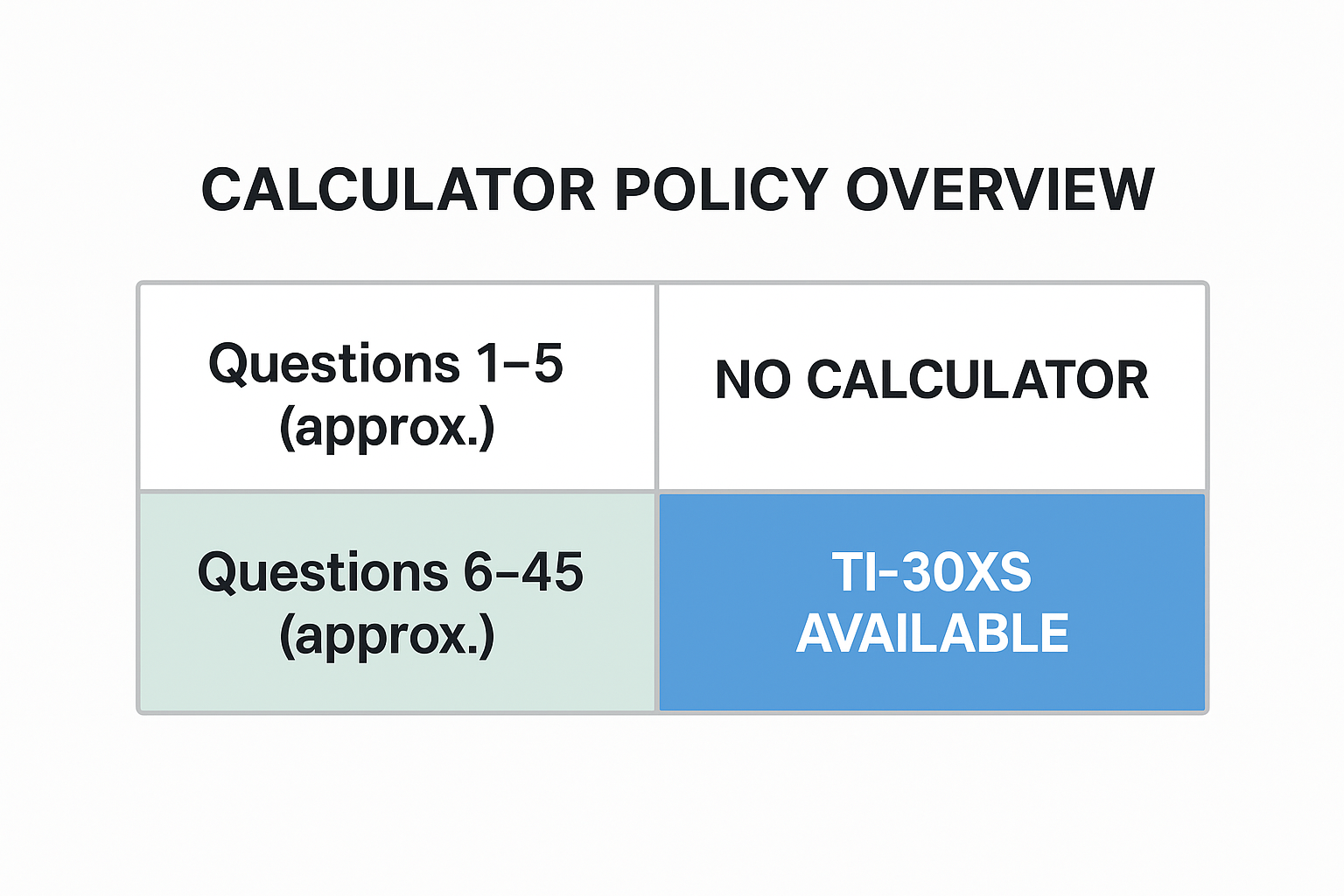
The TI-30XS MultiView™ is the on-screen calculator available for the GED Mathematical Reasoning test. You don't need to bring your own — it appears on your screen as a virtual tool. However, the calculator is not available for the entire test.
View original ASCII
CALCULATOR POLICY OVERVIEW
┌─────────────────────────────────────────────────────┐
│  Questions 1–5 (approx.)   │  NO CALCULATOR         │
│  Questions 6–45 (approx.)  │  TI-30XS AVAILABLE     │
└─────────────────────────────────────────────────────┘
The first section of the test — roughly the first five questions — is calculator-free. These questions are specifically designed to be solvable with mental math or simple paper-and-pencil calculations. The purpose is to verify that you have genuine number sense, not just button-pressing skill.
⚠️ Common Mistake — Mistake 2: Some learners spend so much time practicing with the calculator that they never build fluency with basic arithmetic. When the calculator-free section appears, they panic. Practice your mental math alongside your calculator skills.
Once you move past the calculator-free section, the TI-30XS becomes available. This is a scientific calculator that handles fractions, exponents, square roots, and basic statistical functions. It is not a graphing calculator, but it is powerful enough for everything the test asks of you.
💡 Pro Tip: The GED testing program offers a free tutorial on the TI-30XS at ged.com. Spend at least one study session learning exactly where the fraction button, exponent key, and square root function are located. Fumbling with calculator mechanics during the real test costs you time you cannot afford to lose.
🧠 Mnemonic: "Five Free, Then Forty" — remember that the first five questions are calculator-free, then the remaining forty open up the TI-30XS.
The Formula Sheet: Your Built-In Cheat Sheet
Here is some genuinely good news: you are not required to memorize the core formulas for this test. A math formula sheet is provided on screen throughout the entire Mathematical Reasoning test — including during the calculator-free section.
The formula sheet includes:
📚 Area formulas — for squares, rectangles, parallelograms, triangles, trapezoids, and circles 📚 Perimeter and circumference formulas 📚 Volume formulas — for rectangular prisms, cylinders, pyramids, cones, and spheres 📚 The Pythagorean Theorem 📚 Key algebra formulas — including the quadratic formula and slope formula 📚 Geometric relationships — such as properties of special right triangles
❌ Wrong thinking: "I don't need to learn the formulas because the sheet gives them to me."
✅ Correct thinking: "I need to understand what the formulas mean and when to use them, because the sheet won't tell me which formula applies to my problem."
The formula sheet is a reference tool, not a substitute for understanding. If a problem asks you to find the volume of a cylinder, the sheet will give you the formula V = πr²h — but you still need to know what r and h represent, how to substitute values correctly, and how to complete the arithmetic. A formula you don't understand is just a string of symbols.
📋 Quick Reference Card: Formula Sheet at a Glance
| 🔒 Category | 📐 Example Formula Provided |
|---|---|
| 📏 Area | Rectangle: A = lw; Circle: A = πr² |
| 📦 Volume | Cylinder: V = πr²h; Cone: V = ⅓πr²h |
| 📐 Geometry | Pythagorean Theorem: a² + b² = c² |
| 🔢 Algebra | Quadratic Formula; Slope: m = (y₂−y₁)/(x₂−x₁) |
💡 Real-World Example: Imagine the test shows you a water tank shaped like a cylinder and asks how many gallons it holds given the radius and height. The formula sheet hands you V = πr²h. But you need to recognize it's a cylinder (not a cone or sphere), plug in the right values for r and h, use your calculator correctly for the multiplication, and possibly convert units. The formula is the starting point, not the whole answer.
Putting It All Together: Your Test Map
You now have a complete architectural blueprint of the Mathematical Reasoning test. You know its length (115 minutes), its approximate question count (45), its two content domains (quantitative and algebraic), its four question formats (multiple choice, fill-in-the-blank, drag-and-drop, and hot spot), its calculator policy (free for most questions, unavailable for the first five), and its formula sheet (provided throughout, but requiring real understanding to use effectively).
This knowledge is more powerful than it might seem. Learners who understand the structure of what they're preparing for make better study decisions — they know where to focus their energy, what skills to practice without a calculator, and why understanding concepts always beats memorizing procedures.
As you move into the next section, you'll take stock of where you currently stand within these domains and begin building a study plan tailored to your specific needs. The map is in your hands. Now it's time to figure out exactly where you're starting from.
Practical First Steps: Taking Stock of Where You Are
Knowing where you want to go is only half the battle — the other half is knowing where you are starting from. Before you dive into studying specific math topics, the single most powerful thing you can do is take an honest inventory of your current skills. This is not about judgment or comparison; it is about gathering information so that every hour you invest in studying delivers the maximum possible return. Think of it like a GPS: before it can give you directions, it needs to know your current location.
Why Self-Assessment Comes First
Many learners make the mistake of studying in a straight line — starting at "the beginning" and working forward, regardless of what they already know or where their real gaps lie. This approach wastes precious time reviewing things you already understand while leaving the topics that actually trip you up untouched.
Self-assessment is the practice of honestly evaluating your own current knowledge and skill level before beginning a structured study plan. A proper self-assessment answers two critical questions:
- 📚 What do I already know reasonably well?
- 🔧 Where do I have gaps, confusion, or zero experience?
The answers to these questions become the foundation of your entire study strategy.
🎯 Key Principle: Targeted studying beats random reviewing every time. Ten hours spent on your actual weak spots will move your score far more than ten hours spent re-reading things you already know.
Taking a Diagnostic Practice Quiz
A diagnostic quiz is a short, low-stakes practice test you take before beginning your formal study, specifically designed to reveal your strengths and gaps rather than to simulate the real exam. Think of it less like a test and more like a health screening — you are looking for information, not a grade.
Here is what an effective diagnostic process looks like:
STEP 1: Find a short practice quiz
         (ged.com, Khan Academy, or this course's materials)
              |
              v
STEP 2: Take it without studying first
         (Honest results only come from uncoached performance)
              |
              v
STEP 3: Review every answer — right AND wrong
         (Correct guesses can mask real gaps)
              |
              v
STEP 4: Sort questions into THREE buckets:
         [ CONFIDENT ] [ SHAKY ] [ NO IDEA ]
              |
              v
STEP 5: Map your results to GED math topic areas
         (See the topic list below)
              |
              v
STEP 6: Use results to prioritize your study plan
⚠️ Common Mistake: Do not skip the diagnostic because you are afraid of seeing a low score. A low score on a diagnostic quiz is not a failure — it is a roadmap. The only genuinely wasted effort is studying without knowing where you need to go.
💡 Pro Tip: When you review your diagnostic answers, pay special attention to questions you got right by guessing. Circle them and put them in your "Shaky" bucket anyway. Correct guesses are not reliable knowledge, and they can create a false sense of confidence.
The GED Math Topic Landscape
Before you can map your diagnostic results to specific study priorities, you need a clear picture of what topics actually appear on the GED Mathematical Reasoning test. The exam draws from two broad domains — quantitative problem solving and algebraic thinking — which together cover a range of specific content areas.
Here is a practical overview of the major topic clusters you will encounter:
| 📋 Quick Reference Card: GED Math Topic Areas | ||
|---|---|---|
| Topic Area | What It Includes | Typical Weight |
| 🔢 Basic Arithmetic | Whole numbers, order of operations, number sense | Foundation for everything |
| ➗ Fractions & Decimals | Simplifying, converting, operating with fractions and decimals | Frequently tested |
| 📊 Ratios & Percentages | Proportions, percent change, interest, tips | Real-world applications |
| 📐 Geometry | Area, perimeter, volume, angles, coordinate plane | ~25% of exam |
| 📈 Linear Equations | Solving for x, graphing lines, slope, systems | Core algebra skill |
| 📉 Functions & Patterns | Interpreting graphs, sequences, function notation | Algebraic reasoning |
| 📦 Data & Statistics | Mean, median, mode, reading charts and graphs | Appears in word problems |
Look at this list after completing your diagnostic and ask yourself: Which of these areas did I struggle with? Which felt familiar? That ranking becomes your personalized study priority list.
🤔 Did you know? Many adults discover during diagnostic assessments that their arithmetic fundamentals are actually quite solid — it is often the algebra and geometry sections that need the most attention. Knowing this early prevents the frustration of spending weeks re-learning things you already know.
Setting a Realistic Target Test Date
Once you understand where you are, the next step is deciding where you want to be — and by when. A target test date is the specific date you plan to sit for your GED Mathematical Reasoning test. This is not a casual goal; it is a concrete commitment that gives your entire study plan structure and urgency.
Choosing your target date involves balancing three factors:
- 🎯 Your current skill level — How large are your gaps?
- 📚 Your available study time — How many hours per week can you realistically commit?
- 🔒 Your personal deadline — Is there a job, college application, or life milestone driving your timeline?
As a general guideline, consider this framework:
Gap Assessment  |  Recommended Prep Time
----------------|------------------------
Few small gaps  |  4 to 8 weeks
Moderate gaps   |  8 to 16 weeks
Major gaps      |  16 to 24 weeks (or more)
⚠️ Common Mistake: Setting a test date that is too soon creates panic and leads to ineffective cramming. Setting a date that is too far away removes urgency and allows procrastination. Aim for a date that feels slightly uncomfortable — close enough to create focus, far enough to allow real learning.
💡 Real-World Example: Imagine Maria, who works full-time and can study for 45 minutes on weekday evenings and two hours on Saturday mornings. That gives her roughly five hours per week. Her diagnostic reveals moderate gaps in geometry and linear equations. For Maria, a 12-week target is realistic — demanding but achievable. She registers for a test date 13 weeks out, giving herself one week of buffer for review.
Structuring Your Study Sessions
How you study matters just as much as how much you study. Research on learning and memory consistently shows that spaced practice — spreading study over multiple shorter sessions — produces significantly better long-term retention than massed practice, commonly known as cramming.
The practical sweet spot for a focused study session is 30 to 60 minutes. Within that window, your brain is engaged and absorbing material actively. Beyond 60 minutes without a break, comprehension and retention typically decline steeply.
Here is a simple structure for a productive 45-minute study session:
[ 0–5 min   ] WARM-UP
               Review yesterday's key concept (flashcards, quick notes)

[ 5–30 min  ] NEW LEARNING
               Study one focused topic or skill
               Work through 3–5 example problems

[ 30–40 min ] PRACTICE
               Attempt 5–10 problems independently
               No peeking at solutions yet

[ 40–45 min ] REVIEW & REFLECT
               Check your work
               Write down what confused you
               Note what you will revisit next session
❌ Wrong thinking: "I need a four-hour block to get anything done." ✅ Correct thinking: "Three focused 45-minute sessions spread across the week will teach me more than one four-hour session."
🧠 Mnemonic: Think S-P-R — Short sessions, Practice actively, Review immediately. Those three habits will carry you through this entire course.
💡 Pro Tip: At the end of every study session, write one sentence that answers: "What is the one thing I learned today?" This tiny habit dramatically reinforces memory consolidation and gives you a running log of your progress.
Using Free Official GED Resources
One of the most underused tools available to every GED learner is the official preparation content at ged.com. The official GED Testing Service website offers free and low-cost resources including:
- 📚 GED Ready® — A short, official practice test that predicts your likelihood of passing the real exam. It is the closest thing to a genuine simulation available.
- 🔧 Free study guides — Downloadable content aligned directly to the actual exam.
- 🎯 Score reporting tools — After taking GED Ready, you receive a detailed breakdown by content area, which pairs perfectly with your diagnostic self-assessment.
⚠️ Common Mistake: Some learners rely exclusively on unofficial prep materials that do not accurately reflect the real exam's format, difficulty, or content weighting. Always anchor your preparation to official resources, using supplementary materials like this course to build understanding and practice.
🤔 Did you know? The GED Testing Service updates its materials regularly to reflect current exam standards. Always check ged.com directly rather than relying solely on older printed study books, which may contain outdated content.
Putting It All Together: Your Personal Starting Plan
By the end of this section, you should be able to sketch out the beginning of a real study plan. Here is a simple action sequence to complete before you begin Lesson 2:
- 🎯 Complete a diagnostic quiz — Use the resources in this course or visit ged.com to take a short practice assessment.
- 📚 Sort your results into the three buckets: Confident, Shaky, and No Idea.
- 🔧 Map your gaps to the GED math topic areas listed in the Quick Reference Card above.
- 🧠 Set your target test date using the prep time framework, then register at ged.com to make it official.
- 📊 Plan your weekly study schedule — Identify three to five 30–60 minute windows each week and protect them like appointments.
Every successful learner who has earned a GED started exactly where you are now: at the beginning, with real gaps, and a plan to close them. The difference between those who pass and those who struggle is rarely intelligence — it is the presence of a clear starting point and the discipline to follow through on small, consistent actions. You now have both.
Common Misconceptions About the GED Math Test
Before you invest a single hour of study time, there is something important to clear up: most of the fear surrounding the GED Math test is built on myths. These misconceptions float around in conversations, online forums, and even in the memories of difficult school experiences — and they can quietly sabotage your preparation before you even begin. This section is your myth-busting toolkit. By the time you finish reading, you will have replaced five of the most damaging misunderstandings with accurate, empowering facts.
Myth 1: "I Have to Memorize Every Formula"
This is perhaps the most widespread fear among GED test-takers, and it stops many people from even trying. The image of sitting down to an exam and suddenly going blank on the formula for the area of a trapezoid is genuinely terrifying — but it is also entirely unnecessary.
The fact: The GED Mathematical Reasoning test provides you with a formula reference sheet directly on the screen during the exam. This sheet includes formulas for area, perimeter, volume, surface area, the Pythagorean theorem, and key algebraic relationships. You do not need to have these memorized cold.
What you do need is something more valuable than memorization: understanding. Knowing when to use the area formula for a circle versus the circumference formula matters far more than reciting both from memory. The test rewards comprehension and application.
FORMULA SHEET RELATIONSHIP

  What it GIVES you:          What YOU bring:
  ┌──────────────────┐        ┌──────────────────┐
  │ Area formulas    │        │ Problem-reading   │
  │ Volume formulas  │   +    │ skills            │
  │ Pythagorean thm  │        │ Knowing WHEN to   │
  │ Quadratic form.  │        │ apply each one    │
  └──────────────────┘        └──────────────────┘
              │                        │
              └────────────┬───────────┘
                           ▼
                    CORRECT ANSWER
💡 Pro Tip: During your studies, practice reading formulas and understanding what each variable means. When you see A = πr², ask yourself: "What is A? What is r? What kind of problem would ask me to find this?" That habit of thinking is exactly what the test rewards.
⚠️ Common Mistake: Some learners spend weeks drilling formula memorization and almost no time practicing how to set up and solve problems. This is backwards. Spend the majority of your time on application.
Myth 2: "The Test Is All Advanced Algebra and Calculus"
Many adults picture the GED Math test as something resembling a college-level calculus course — dense with abstract equations, proofs, and symbols they have never seen. This image keeps capable people from registering for the exam.
The fact: The GED Mathematical Reasoning test is divided into two major content areas, and they are roughly balanced:
📋 Quick Reference Card: GED Math Content Breakdown
| 📚 Content Area | 🔢 Approximate Weight | 🔧 What It Includes |
|---|---|---|
| 🎯 Quantitative Reasoning | ~45% | Ratios, proportions, percents, measurement, data interpretation, basic statistics |
| 🧠 Algebraic Reasoning | ~55% | Expressions, equations, inequalities, functions, linear graphs |
Notice what is not on that list: calculus, trigonometry, logarithms, or advanced proofs. The algebra involved is foundational — the kind used to figure out a payment plan, compare cell phone deals, or calculate how long a road trip will take. Quantitative reasoning, which makes up nearly half the test, is essentially structured common sense applied to numbers.
💡 Real-World Example: A question might show you a bar graph of monthly electricity bills and ask which month had the highest cost, or by how much two months differed. That is quantitative reasoning — reading, interpreting, and drawing conclusions from data. No complex formulas required.
🎯 Key Principle: The GED is designed to certify that you have the mathematical skills of a high school graduate entering the workforce or college. It reflects real-life math, not graduate-school math.
Myth 3: "Having a Calculator Means the Math Is Easy"
When learners discover that the TI-30XS calculator is available for most of the GED Math test, some assume the hard work is done for them. Others go in the opposite direction and worry that if the calculator is there, the questions must be impossibly difficult. Both reactions miss the point.
The fact: A calculator handles computation — adding, subtracting, multiplying, dividing, and more. But the majority of what the GED Math test measures is logical reasoning and problem setup. You must first understand what the problem is asking, identify the correct mathematical operation or strategy, and set up the solution correctly. Only then does the calculator help you crunch the final numbers.
PROBLEM-SOLVING PROCESS

  READ the         UNDERSTAND       SET UP the       CALCULATE
  problem     →   what's asked  →  equation/      →  the answer
  carefully        (No calculator    strategy         (Calculator
                    helps here)     (No calculator    helps here)
                                     helps here)

   ◄─────────────── Your Thinking ───────────────►  ◄── Tool ──►
Consider this example: "A contractor charges $45 per hour and a flat materials fee of $120. If a customer's total bill was $435, how many hours did the contractor work?"
The calculator will not tell you to write the equation 45h + 120 = 435. That insight — recognizing this as an algebra problem, setting up the equation, and isolating h — comes entirely from you. The calculator then confirms that h = 7.
❌ Wrong thinking: "I have a calculator, so I just need to punch in numbers." ✅ Correct thinking: "I need to understand the problem first, then use the calculator to confirm my math."
🤔 Did you know? Some questions on the first section of the GED Math test are calculator-prohibited. These tend to test number sense and mental math skills, reminding us that foundational understanding — not tool dependency — is the real goal.
Myth 4: "You Have to Pass All Four Subjects at Once"
Some people delay taking the GED because they feel they need to be ready for everything simultaneously — science, social studies, reasoning through language arts, and math — all in one sitting. The mental weight of that expectation is enormous, and it is completely unnecessary.
The fact: The GED is structured as four separate, independent subject tests. You can take them one at a time, in any order, on different days, across different months. If you pass Mathematical Reasoning today but want more time to prepare for Science, you keep your math score and focus on Science next.
GED SUBJECT TEST INDEPENDENCE

  ┌─────────────────────┐   ┌─────────────────────┐
  │  Mathematical       │   │  Reasoning Through  │
  │  Reasoning          │   │  Language Arts      │
  │  ✅ Pass whenever   │   │  📅 Take when ready │
  └─────────────────────┘   └─────────────────────┘

  ┌─────────────────────┐   ┌─────────────────────┐
  │  Science            │   │  Social Studies     │
  │  📅 Take when ready │   │  📅 Take when ready │
  └─────────────────────┘   └─────────────────────┘

  Each subject = Independent passing score
  All four passed = GED Diploma earned
This structure means you can build momentum strategically. If math is your strongest area, pass it first and let that win fuel your confidence for the subjects that need more work. If math needs the most attention, invest your time there without the pressure of simultaneously preparing for three other subjects.
💡 Mental Model: Think of the GED like four separate finish lines in a road race. You do not have to cross all four at the same moment. You earn a medal as you cross each one, and the full trophy waits when you have crossed them all.
⚠️ Common Mistake: Waiting until you feel "ready for everything" before scheduling any test. This often leads to indefinite postponement. Schedule the subject you feel most prepared for first — that first passing score is a powerful motivator.
Myth 5: "If You Failed Math in School, You Cannot Pass This Test"
This may be the most emotionally loaded myth of all. For many adults returning to education, past academic struggles feel like permanent verdicts. A bad grade in ninth-grade algebra can feel like proof of a fixed limit. It is not.
The fact: Struggling with math in school reflects the circumstances of that time — perhaps a difficult teacher, a chaotic home life, undiagnosed learning differences, or simply a curriculum that moved faster than you could process. None of those circumstances define your capacity to learn math now, as a motivated adult with a clear goal.
Decades of educational research confirm a powerful concept called neuroplasticity — the brain's ability to form new connections and develop new skills at any age. What changes outcomes in adult math learning is not raw talent. It is focused, structured, consistent practice.
🎯 Key Principle: The GED Math test does not care how you performed in school 10, 20, or 30 years ago. It only measures what you can demonstrate on test day.
💡 Real-World Example: Adults who struggled with fractions in middle school regularly master the concept within a few focused weeks of practice when they have clear explanations, worked examples, and the motivation of a meaningful goal. The content is learnable. You are capable.
🧠 Mnemonic: Think of the word FRESH to reframe your math journey:
- F — Focused study beats scattered cramming
- R — Repetition builds fluency over time
- E — Errors are information, not failures
- S — Small wins compound into big progress
- H — History does not determine your future
Putting It All Together: A Clearer Picture
Let us step back and see how these five corrections reshape the entire landscape of GED math preparation:
| ❌ The Myth | ✅ The Fact |
|---|---|
| Must memorize all formulas | Formula sheet is provided; focus on understanding |
| Test is full of calculus | Roughly half is everyday quantitative reasoning |
| Calculator makes it easy | Reasoning and setup are still entirely your job |
| Must pass all subjects at once | Four independent tests, take at your own pace |
| Past failure = future failure | Focused practice produces real improvement |
Clearing away these myths does not just make you feel better — it changes how you study. You stop wasting energy on the wrong things (memorizing formulas you will be given) and start investing it in the right things (practicing problem setup, building reasoning skills, and working through content steadily). That shift in strategy is worth more than any single study tip.
🎯 Key Principle: Accurate information is the foundation of effective preparation. Every hour you study based on a false picture of the test is a partially wasted hour. Now that you have the real picture, every hour you invest is pointed in exactly the right direction.
Carry these corrections forward with you. When doubt creeps in — when you hear a voice saying "this is too hard" or "I was never good at math" — come back to this section and remember: those voices are reciting myths, not facts.